
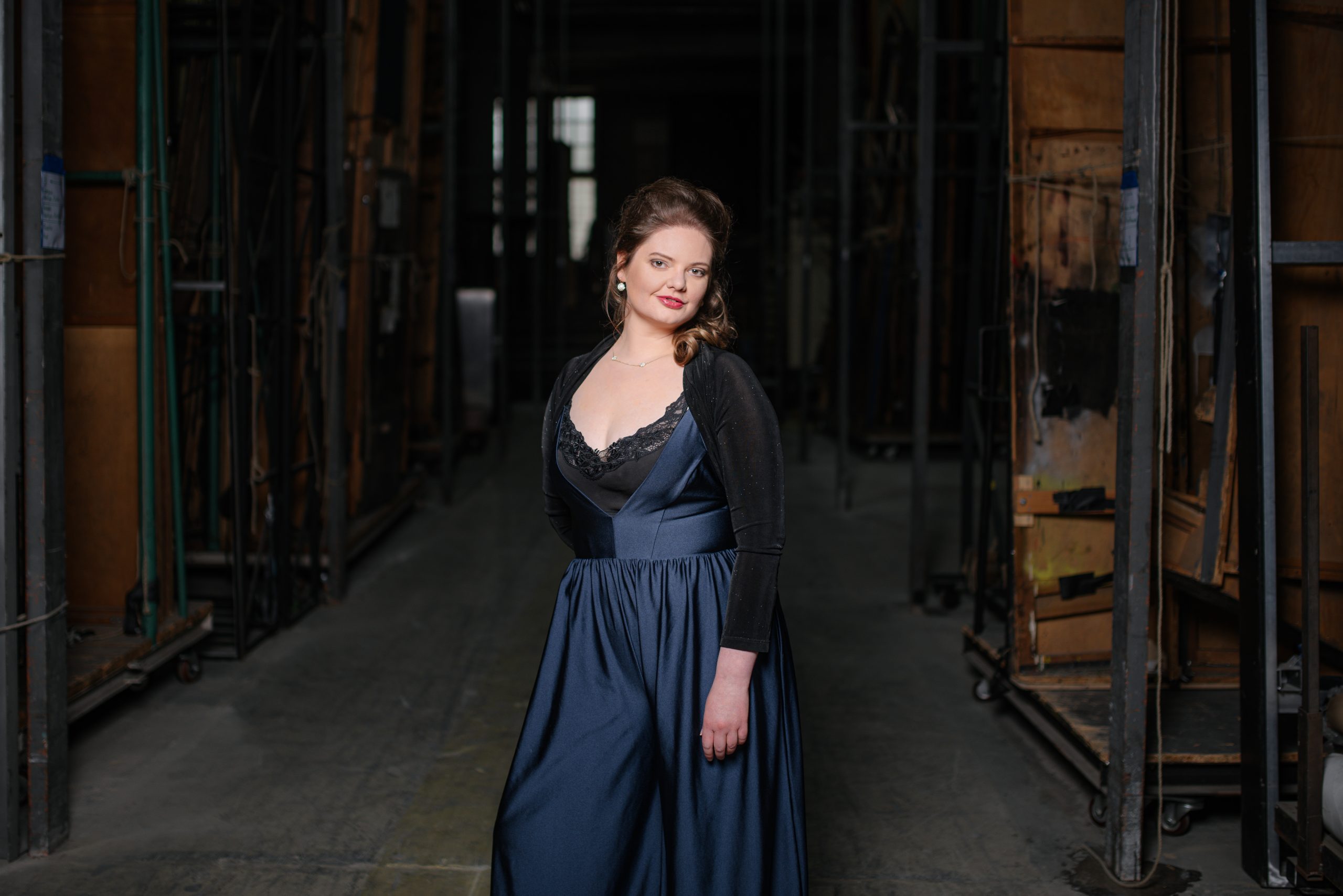
Flurina Stucki
The young dramatic Swiss soprano Flurina Stucki has established herself over recent seasons, with demanding operatic roles as well as numerous significant role debuts, as a singer of extraordinary expressive power, intense stage presence and the highest level of vocal artistry. Her artistic focus lies on the great dramatic female characters of the Wagner and Strauss repertoires, as well as the Italian repertoire.
She has worked with renowned conductors including Sir Donald Runnicles, Simone Young, Daniel Cohen, Juraj Valčuha, Georg Fritzsch, Dirk Kaftan, Giacomo Sagripanti, Nicholas Carter, Roland Kluttig, Andrea Sanguineti, Carlo Montanaro, Ronald Zollman and Stephan Zilias, as well as with directors including Ersan Mondtag, Roland Schwab, Philipp Stölzl, Stefan Herheim, Benedikt von Peter, David Hermann, Tobias Kratzer, Evgeny Titov and Lorenzo Fioroni.
In the 2026/27 season, Flurina Stucki will appear as Leonore (Fidelio) at the Sommeroper Selzach in her native Switzerland. At the Semperoper Dresden, she returns as Fata Morgana (Die Liebe zu den drei Orangen), continuing her successful collaboration with the house. Further highlights of the season include her role debut as Amelia (Un ballo in maschera) at the Theater Lübeck, as well as her house debut as Elsa (Lohengrin) at the Aalto-Musiktheater Essen.
In the past season, she appeared at the Deutsche Oper Berlin as Senta (Der fliegende Holländer) and Contessa (Le nozze di Figaro). At the Semperoper Dresden, she returned as Fata Morgana (Die Liebe zu den drei Orangen). Further highlights included her role debut as Salomé at the Theater Coburg, followed by a guest performance in the same role at the Théâtre du Capitole Toulouse. She also returned as Elsa (Lohengrin) at the Staatstheater in Karlsruhe.
A formative stage in her artistic development was her time as a member of the ensemble of the Deutsche Oper Berlin, with which she was associated from 2019 to 2026, before continuing her career as a freelance artist from the 2026/27 season onwards.
There, she developed a versatile repertoire and interpreted, among others, Donna Anna (Don Giovanni), Konstanze (Die Entführung aus dem Serail), Rosalinde (Die Fledermaus), Chrysothemis (Elektra), Freia and Helmwige in the Ring cycle, Leonore (Fidelio), Elsa (Lohengrin) and Christine Storch (Intermezzo). Her interpretation in Ersan Mondtag’s opulent production of Rued Langgaard’s Antikrist also attracted considerable attention; the production was released on DVD by Naxos.
In parallel, she received invitations to the opera houses in Karlsruhe (Chrysothemis/Elektra), Wiesbaden (Leonore/Fidelio), Coburg (Senta/Holländer) and Lübeck (Amelia/Simon Boccanegra), to Graz for Britten’s staged War Requiem, to Basel (Christine Storch/Intermezzo), to the Semperoper Dresden (Die Liebe zu den drei Orangen/Fata Morgana and Rosalinde/Die Fledermaus), as well as to the Bayreuth Festival, where she appeared as the Shepherd (Tannhäuser) and as a Flower Maiden (Parsifal).
Flurina Stucki is also regularly present in the concert field. Her important concert projects include Strauss’s Vier letzte Lieder with the Grazer Philharmoniker as well as Alexander von Zemlinsky’s Lyrische Sinfonie under Sir Donald Runnicles at the Deutsche Oper Berlin. She sang Soprano I in Gustav Mahler’s Symphony No. 8 with the Orchestra Sinfonica e Coro Sinfonico di Milano under the direction of Claus Peter Flor in Milan Cathedral, and stepped in at short notice for Alban Berg’s Sieben frühe Lieder in concerts with the Göteborg Symphony Orchestra under Simone Young.
Flurina Stucki studied voice and music education at the Musikhochschule Basel with Isolde Siebert, as well as opera at the Hochschule für Musik Karlsruhe with Prof. Christiane Libor and Stephan Klemm.